
Dell (DELL) Pre-Earnings Deep Dive - Nov 24, 2026
Black Friday / Cyber Monday offer: In our 200-question benchmark, adding Distilla took Claude from 18% to 95% on stock questions across companies or over time. Try it yourself at 25% off with code BFCM25 through Tue 1 Dec. Sign up here.
Editor's Notes:
- Dell (DELL) reports tonight, and the question is not whether it beats. It has beaten five quarters running and the backlog is public. The question is what the backlog is made of. In the last quarter Dell took in a record volume of AI server orders while its own financing arm lent customers an extra six billion dollars and its inventory doubled. Put plainly, Dell is lending to the buyers and holding the parts. That is the same shape as Nebius (NBIS) booking receivables against prepayments and Nvidia (NVDA) taking stakes in its customers, one layer further down the chain. The number to watch tonight is cash from operations, not revenue. If it falls again while the backlog grows, the AI server business is funding its customers, and the market has already shown this month what it thinks of that.
What is the market setup for Dell Technologies (DELL) Q3 FY2027 earnings?
Dell Technologies reports Q3 FY2027 earnings tonight, Tuesday, November 24, post-market. Wall Street consensus has converged around revenue of $49.27 billion (representing a massive +83% year-over-year growth rate compared to the $49.00 billion midpoint of management guidance) and a Non-GAAP EPS of $6.62 (Zacks consensus sits at $6.55 versus $2.59 last year). Due to accelerating server pipelines, buy-side whisper numbers are highly elevated, demanding an EPS print of at least $7.25 to sustain current valuations.
Options markets are pricing in a highly volatile +/-17% implied move post-close. Following Monday's +20.83% surge—which added nearly $20 billion to Dell's market capitalization in sympathy with Nvidia's strong data center trends—a significant portion of a "perfect" beat-and-raise scenario is already priced into the stock.
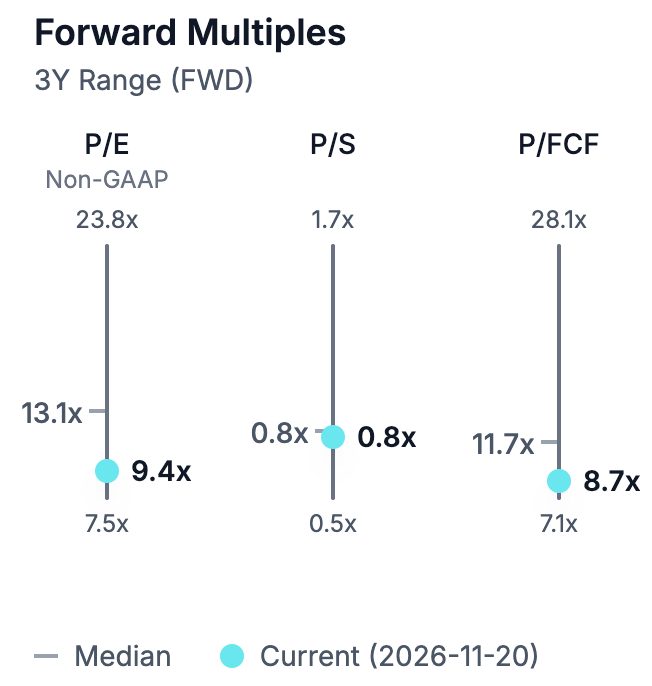
Historically, Dell’s post-earnings drift pattern exhibits severe asymmetric volatility. While the company has established a reputation as a consistent beater—delivering five consecutive quarterly EPS beats with an average Q2 surprise of +43.7%—the stock historically corrects sharply post-print whenever reported free cash flow (FCF) or gross margins fail to scale alongside top-line AI server shipments.
Beyond Dell, tonight’s print carries critical systemic implications for the entire AI hardware value chain. It will validate the sequential demand translation from upstream silicon provider Nvidia to system integrators like Hewlett Packard Enterprise (HPE) and Lenovo, while testing the financial solvency of downstream neocloud service providers who are aggressively leasing graphics processing unit (GPU) capacity.
Dell Earnings Cheat Sheet: Key Metrics and Consensus Estimates
This table outlines the historical performance patterns and key thresholds required for a post-earnings move tonight:
| Metric | Historical Pattern | Avg Beat Magnitude | Confidence | Key Thresholds for Tonight |
|---|---|---|---|---|
| AI Server Revenue (ISG) | Conservative management sandbagging; FY27 target raised to $74.0B. | +12% to +18% | High | Beat: >$20.5B Miss: <$18.5B |
| ISG Operating Margin | Diluted by low-margin AI server mix; offset by proprietary storage. | +50bps to +100bps | Medium | Beat: >12.5% Miss: <10.0% |
| External Storage Revenue | Highly resilient enterprise demand; historically underpromised. | +4% to +6% | High | Beat: >$5.10B Miss: <$4.70B |
| CSG (PC) Operating Margin | Constrained by component inflation and deep volume declines. | In-line to -20bps | Low | Beat: >6.5% Miss: <5.5% |
Where do consensus estimates for Dell diverge from reality?
- External Storage estimates look too low at $4.83 billion: Channel checks and NetApp's recent strong guidance revisions suggest enterprise on-premises data modernization is accelerating. This high-margin proprietary storage segment (PowerStore/PowerFlex) is highly likely to surprise to the upside, serving as the primary buffer against AI server margin dilution.
- CSG (PC) Operating Margin looks too high at ~6.0%: Third-quarter industry data from IDC revealed a catastrophic 25.0% year-over-year decline in Dell’s PC shipments, falling to 7.6 million units. Coupled with sequential DRAM and NAND contract price inflation, Dell has zero pricing power in legacy commercial client hardware, leaving CSG margins vulnerable to dropping below the 5.5% floor.
- Free Cash Flow Consensus is unrealistically optimistic: Wall Street models assume a normal cash conversion cycle. However, with inventory days stretched to a near-record 52.3 days and massive component prepayments, cash generation is highly likely to miss the consensus estimate of $2.2 billion.
Is Dell's $95 Billion AI Infrastructure Backlog Real or Synthetically Financed?
The core pillar of the bullish Dell investment thesis is its monumental $95.0 billion AI infrastructure backlog, which has expanded exponentially from $18.4 billion in Q3 FY26 and $51.3 billion in Q1 FY27. However, an in-depth analysis of Dell's balance sheet reveals that this backlog is highly synthetic and relies on high-risk customer financing structures.
AI Server Backlog Trajectory:
- Q3 FY2026: $18.4 Billion
- Q4 FY2026: $43.0 Billion
- Q1 FY2027: $51.3 Billion
- Q2 FY2027: $95.0 Billion
The Key Financial Red Flags
- The Neocloud Credit Concentrator: Dell’s customer base for AI-optimized servers is highly concentrated. Evercore ISI estimates that just three entities—CoreWeave, xAI, and IREN—account for approximately 70% of Dell's FY2027 AI server revenue. These are highly leveraged, sub-investment grade neocloud players whose capital structures depend entirely on their ability to continuously raise debt against their GPU collateral.
- Ballooning Customer Financing Receivables: Dell's total financing receivables have surged to $20.4 billion. Most alarmingly, lowest-credit-tier (sub-investment grade) receivables more than doubled to $4.4 billion in the first half of FY27 (up from $1.8 billion). Essentially, Dell is aggressively vendor-financing its own customer base to artificially inflate its AI server backlog. If these neoclouds fail to monetize their rented compute, or if hyperscalers flood the market with cheaper cloud capacity, Dell's backlog is merely paper, exposing the company to massive bad-debt write-downs.
- The 25% to 45% Repricing Squeeze: Memory suppliers Samsung, SK Hynix, and Micron are pushing through a 25% to 45% contract price hike for DRAM and NAND. If Dell attempts to pass these rising costs through to its debt-strapped neocloud customers, it risks triggering project delays or cancellations. If Dell absorbs these costs, its server margins will collapse toward the commoditized ~12.7% levels seen at peer Super Micro.
How has the market narrative for Dell stock evolved over the past 90 days?
The market narrative surrounding Dell has undergone a highly volatile transformation, shifting through three distinct phases over the past 90 days:
- The Pure AI Beneficiary (September): Following the Q2 FY27 earnings release, consensus hailed Dell as the king of the enterprise AI buildout. The narrative focused entirely on the $95.0 billion backlog, five consecutive EPS beats, and an upward revision of FY27 revenue guidance to $192.0 billion.
- The Quality & Credit Hangover (October - Mid-November): The narrative turned bearish as the market digested the quality of this growth. A Barclays downgrade highlighted that Dell's revenue growth was artificially inflated by passing through skyrocketing memory costs rather than high-margin software integration. Simultaneously, the Federal Reserve's November 13 Financial Stability Report issued a warning regarding circular financing in the AI chip supply chain. When Intel forecast a multi-year PC demand contraction and IDC reported Dell's 25% unit shipment collapse, the stock suffered a brutal 30% pull-back from its highs.
- The Violent Re-Rating (Late November): On Monday, November 23, the narrative drifted back to hyper-optimism. Driven by Nvidia’s strong data center trends, the market aggressively bought back into the $95.0 billion backlog story, driving a +20.83% single-day spike.
While Street consensus has raised FY27 EPS estimates to $25.90 (up 41% over 90 days), analysts have simultaneously compressed their price targets (Morgan Stanley cut from $511 to $403; Citi cut from $600 to $550) to account for multiple contraction across the hardware peer group.
What did Dell's management reveal in their last earnings call?
A systematic linguistic analysis of Dell’s Q2 FY27 earnings call reveals several defensive shifts in management’s tone compared to prior quarters:
- From Pricing Management to Hard Constraints: In earlier quarters, management described memory cost inflation as a manageable dynamic to be mitigated via "dynamic pricing." In Q2, the language intensified. Management explicitly labeled memory (DRAM and NAND) as the primary constraint, warning that they expect to exit the year with a meaningful backlog due to supply constraints, not a lack of demand. This is a clear signal of an operational bottleneck limiting immediate revenue conversion.
- AI Server Unit Economics Admission: Under questioning, management admitted that large AI deals remain highly competitive and aggressively priced. While expressing confidence in maintaining mid-single-digit operating margins for AI servers, the celebratory tone around AI profitability has been replaced with a defensive focus on high-margin storage attach as the primary path to defend consolidated gross margins.
- De-emphasis on Capital Returns: Prior calls featured celebratory opening remarks regarding record capital returned to shareholders and aggressive share buybacks. The Q2 commentary muted this language, focusing instead on capital preservation as Cash Flow from Operations fell 47% year-over-year to $2.2 billion due to the working capital requirements of the AI server buildout.
- Explicit Credit Risk Disclosures: For the first time, management formally introduced risk-factor language addressing the concentration of revenue from a relatively small number of large customers and cloud service providers for AI-optimized servers, validating the market's anxiety regarding neocloud credit exposure.
How do earnings reports from HPE, HPQ, and Super Micro impact Dell?
Recent earnings reports from Dell's closest hardware competitors paint a challenging picture for tonight's report:
- Hewlett Packard Enterprise (HPE): HPE delivered strong Q4 FY26 revenue growth of +50% year-over-year and raised its FY27 outlook, confirming that high-end enterprise AI data center demand remains robust. However, HPE’s print also confirmed that massive service investments and component inflation are limiting operating leverage, indicating that Dell’s ISG margins will remain under sequential pressure.
- HP Inc. (HPQ): HPQ's leading indicators confirm that the broader PC market volume remains severely depressed. While HPQ is successfully driving a 46% mix of high-ASP premium AI PCs to defend its personal systems segment, the volume collapse means Dell's Client Solutions Group (CSG) cannot act as a reliable cash cow to fund the AI buildout.
- Super Micro Computer (SMCI) & Lenovo: SMCI’s gross margins compressing to 12.7% serves as a warning that pure-play server assembly is a low-margin business. While SMCI’s compliance crisis and the loss of a ~$1.1 billion Oracle server rack contract represent a market-share windfall for Dell, Lenovo is aggressively competing. Lenovo’s ISG revenue rose 177% year-over-year, and its AI server backlog jumped to $80.0 billion, proving that Dell faces intensifying price competition to secure Tier-1 hyperscale deals.
What is the bear case for Dell Technologies stock?
The bear case rests on four areas:
| Vulnerability Area | Key Structural Threat |
|---|---|
| Circular Financing Risk | $4.4 billion in sub-investment grade customer financing receivables are exposed to highly leveraged neocloud entities, vulnerable to a single default or asset re-rating. |
| Working Capital Drain | Inventory days are at 52.3 days (2.2x historical average), locking up cash in unbilled parts. Payable days of 122.2 are unsustainable and threaten to freeze share buybacks if normalized. |
| Core PC Collapse | Dell's commercial PC shipments fell 25% year-over-year in Q3, crushing the high-margin segment that historically generated the cash flow to support debt and dividend payments. |
| AI Server Margin Trap | Chasing low-margin AI server assembly contracts dilutes consolidated gross margins toward Super Micro's low 12.7% levels. Insiders have responded by dumping $991 million in stock over 90 days. |
Four Critical Watchpoints During the Call
- FY27 AI-Server Revenue Target (Currently $74.0 Billion): To justify Monday’s rally, management must raise this target to at least $82.0–$85.0 billion, reflecting accelerated supply allocation of Nvidia’s next-generation architectures.
- Backlog-to-Shipment Conversion Ratio: Watch for any commentary regarding how quickly Dell is converting its $95.0 billion backlog into recognized revenue. Any indication that component shortages are extending shipment timelines beyond 12 weeks will penalize the stock.
- ISG Operating Margin and Component Cost Pass-Through: Look for commentary on how Dell is navigating SK Hynix/Samsung DRAM contract pricing. If management admits to absorbing component inflation to protect its Tier-1 relationships, ISG margins will compress.
- Underwriting Criteria for the $4.4 Billion Neocloud Financing Pool: Analysts must press management on the credit quality of the lowest-tier customer receivables. Any sign of loosening credit standards to secure server wins will validate the circular financing bear case, triggering a sharp re-rating.
Disclaimer: This content is generated using AI, synthesizing public data (filings, reports, news) and social media (Reddit, X). It may contain errors, inaccuracies, or hallucinations. Nothing herein constitutes financial advice. This newsletter is for informational purposes only; please consult a qualified professional and conduct your own due diligence before making any investment decisions.